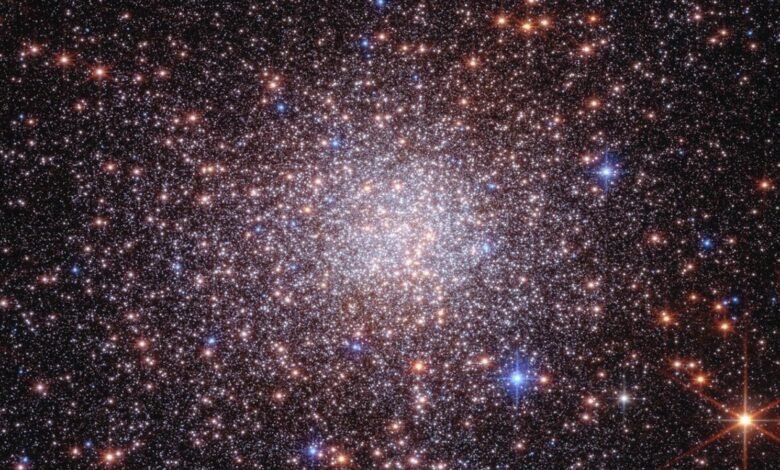
Terzan 5 is a stellar system orbiting within the Milky Way galaxy’s bulge, which is an incredibly bright, crowded central region of the galaxy. Not only are stars within the bulge tightly packed together — every bit of this region is laced with thick clouds of gas and dust. The James Webb and Hubble Space Telescopes joined forces to study Terzan 5. Astronomers already knew that this star cluster was unusual in that it contained two stellar populations of very different ages. New research found strong evidence for two more stellar populations, one that formed 3.8 billion years ago and another only 2.5 billion years ago. The research team also was able to determine the ages of the previously known stellar populations with unprecedented precision, finding that they formed 12.5 billion and 4.7 billion years ago. This finding proved that Terzan 5 is not a globular star cluster, as originally classified. Instead, Terzan 5 belongs to a new category, known as a bulge fossil fragment — a self-contained, self-enriching stellar system with multiple star populations of different ages and with different iron abundances. Terzan 5 is 22,000 light-years away in the constellation Sagittarius. It contains about 2 million times the Sun's mass packed into a stellar system only a few tens of light-years across, making it one of the most massive and densely populated globular-cluster-like systems in the Milky Way. This image was created with Hubble data from proposal: 12933 (F. R. Ferraro) and Webb data from proposal: 5502 (F. R. Ferraro). [Image description: A dramatically crowded starfield that looks like a just-shaken snow globe. The black background of space, which is clearer at the edges, is covered by thousands of tiny white, orange, and blue points of light, which are stars. The stars are most concentrated in the centre, forming a roughly circular orb, and sparser at the edges of the image. Several larger orange stars, particularly those largest near the edges of the frame, have prominent diffraction spikes.]
كشفت الأبحاث التي أجراها فريق من علماء الفلك باستخدام تلسكوب جيمس ويب الفضائي عن ظاهرة جديدة تدعى “شظايا البروز الفوسيلية”، والتي تسلط الضوء على تاريخ تشكّل المجرة. يركز العلماء على منطقة تُعرف باسم “ترزان 5” ضمن مركز مجرتنا، والتي تُعتبر صعبة الدراسة بسبب كثافة النجوم ووجود الغبار.
أسفرت الملاحظات باستخدام تلسكوب ويب، بالإضافة إلى البيانات الأرشيفية من تلسكوب هابل الفضائي، عن تأكيد أن ترزان 5 ليس تجمعًا نجميًا كرويًا، كما كان يُعتقد سابقًا. فالتجمعات الكروية عادة ما تحتوي على جيل واحد قديم من النجوم، بينما يُظهر ترزان 5 مراحل متعددة لتشكيل النجوم، حيث عُثر على مجموعتين من النجوم القديمة التي تشكلت قبل 12.5 مليار و4.7 مليار سنة، بالإضافة إلى مجموعتين أحدثين تشكلتا قبل 3.8 مليار و2.5 مليار سنة.
أوضح البروفيسور فرانشيسكو ر. فيرارا، الباحث الرئيسي للملاحظات، أنه “لسبب ما، تشكّل هذا العنقود الفريد من النجوم بشكل مستقل عن البروز ولم يتم تدميره مع تشكّل البروز نفسه”. وأضاف: “ترزان 5 يُصنف الآن كشظية فوسيلية للبروز، لأنه يُشبه الكتل البدائية التي ساهمت في تشكيل البروز”.
من جانبها، أكدت الدكتورة باربرا لانتزوني، وهي أستاذة مساعدة في جامعة بولونيا، أن “التحليلات والم simulations العميقة تُظهر أن المجرات في الكون المبكر كانت تمتلك أقراصًا ضخمة من الغاز الذي تفتت إلى كتل وكونت نجومًا؛ هذه الكتل تحركت إلى مركز المجرات، واندماج العديد منها أسفر عن تكون البروز”.